TIG welding in industry: where is it best used and why?
TIG welding is a shielded inert gas welding method, also known as TIG welding. The process uses a tungsten electrode, making it a non-consumable welding method.
Simply put, TIG welding involves creating an electric arc between the electrode and the material, while simultaneously protecting the weld pool with noble gases. The flow of shielding gas is crucial, protecting the weld from oxidation and enabling low-oxide TIG welding.
The process can be performed as:
Wireless welding – when the elements are joined without the addition of a filler metal
Wire welding or TIG welding with a wire, when a filler material is used
The method is available as:
Manual welding – the classic manual welding method
Automatic welding
Robotic welding, supported by welding robots
TIG Welding – Applications in Various Industries
TIG welding is used wherever welding precision, weld aesthetics, and high weld quality are crucial.
The applications of TIG welding are extensive and encompass both high-precision industries and traditional industrial production. In the advanced technology sector, TIG welding is particularly important in the aerospace industry, where it is used to join structural components, thin-walled elements, and parts requiring the highest precision. Thanks to its stable arc and temperature control, the method ensures high-quality joints in demanding materials such as aluminum alloys and special steels.
TIG welding is equally important in the mechanical industry, where this technology is used to produce machine parts, housings, structural components, and components operating under high loads. In this area, repeatability and the ability to achieve welds with high metallurgical purity are key.
TIG welding also finds significant applications in the installation sector. The pipeline industry utilizes this method in the construction of technological, energy, and process installations, as TIG welding of pipelines allows for tight and durable joints. Similarly, in the manufacturing industry, TIG welding is used in installations where quality control and corrosion resistance are essential.
This technology plays a significant role in the sheet metal processing industry, particularly in projects requiring the welding of thin sheets. In these applications, TIG allows for precise arc control and limited material deformation, which is important in the production of housings, tanks, and decorative elements. Similar advantages make TIG welding frequently used in steel structures and engineering projects requiring high aesthetics and durability of welds.
Beyond heavy industry, TIG welding is also used in many other sectors of the economy. In the automotive industry, TIG welding is used for the production of exhaust systems, bodywork components, aluminum components, and tuning parts. TIG welding in electronics allows for the joining of small metal components and device housings where exceptional precision is required.
This technology is also present in construction and structural design. TIG welding in construction is used for steel elements, balustrades, and special structures, while TIG welding in architecture is used for projects requiring high aesthetics—e.g., decorative elements, stainless steel structures, or visible structural details. TIG welding is also increasingly used in infrastructure, such as industrial installations, public facilities, and technical systems.
In practice, the method proves effective in both mass production and individual projects. TIG welding in production enables consistent component quality, while TIG welding in services allows for the completion of custom orders, repairs, and modernizations. In many cases, the technology is used as early as the concept stage, making it important to incorporate it into structural and technological designs. This means that today, this method, known as TIG welding, is widely used in industrial sectors and modern production processes.
TIG Welding of Materials – What Can Be Welded?
TIG welding of materials is used in many industries because the process provides excellent arc control and stable melting conditions. This makes the technology suitable for both structural materials and alloys requiring particularly clean welds. In practice, it allows for joining a wide range of metals – from stainless steels to lightweight aluminum alloys.
TIG welding of materials covers a wide range of raw materials:
Ferrous and high-alloy metals
Stainless steel welding
High-alloy materials welding
Structural steels
Non-ferrous metals
Non-ferrous metal welding
Aluminum welding
Aluminum alloys
Aluminum alloy welding
In practice, TIG welding of lightweight materials allows for temperature control, making it ideal for thin sheets and precision components.
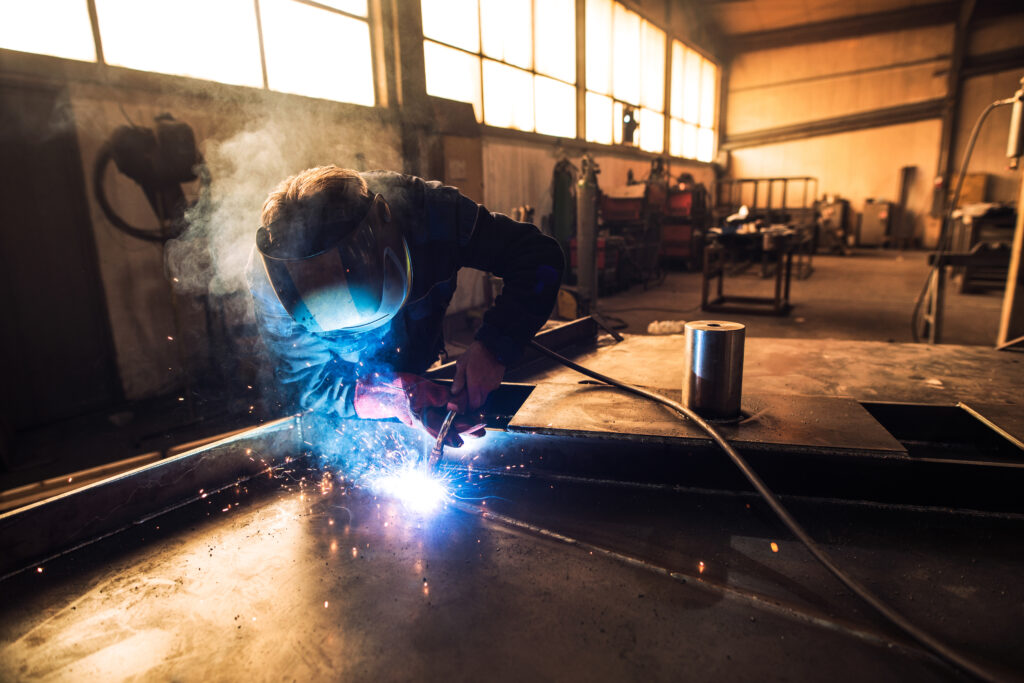
TIG Welding in Industrial and Technological Applications
TIG welding in industrial applications encompasses both mass production and specialized projects. This method is particularly valued where repeatability, process cleanliness, and the ability to achieve welds with high aesthetics and durability are key. Thanks to the extensive control over operating parameters, TIG welding in production processes allows for meeting stringent quality requirements in many industries.
This technology is used in:
TIG welding in equipment
TIG welding in machinery
TIG welding in components
TIG welding in details
TIG welding in products
The following are increasingly used:
Orbital welding
ArcTig systems
Automated production lines
This demonstrates the growing role of TIG welding in technology, TIG welding in innovation, and TIG welding in industrial development.
Technological parameters – current, gas, and process control
Depending on the material, the following methods are used:
direct current welding
alternating current welding
Alternating current is particularly useful for welding aluminum
In practice, TIG welding should be adapted to:
rodzaju materiału
grubości
wymagań jakościowych
Therefore, TIG welding should be technologically planned at the TIG welding design stage and during TIG welding production processes.
Advantages of TIG Welding
One of the most important reasons why TIG welding is so valued in industry is the extremely high quality of welds obtained with this process. This technology allows for the creation of joints with stable parameters, which also enables repeatable weld quality, particularly important in mass production and in industries with high technological requirements.
A significant advantage of this method is also the perfect aesthetic appearance of the weld, making TIG welding widely used for aesthetically pleasing structures and visible elements, such as in architecture, the automotive industry, and the food industry. The process also provides excellent control over the arc and weld pool, resulting in controlled welding precision even with thin materials.
In practice, TIG welding is one of the most versatile methods, as it allows for both wireless welding and welding with filler metal, i.e., wire welding, depending on the project requirements. This makes the technology ideal for welding thin sheets, precision components, and materials requiring minimal heat input.
These advantages of TIG welding make it the preferred method wherever quality, durability, and reliability of joints are important—from industrial production to advanced engineering projects.
Disadvantages of TIG Welding
Although the technology is advanced, there are also disadvantages of TIG welding:
lower welding efficiency than MIG/MAG
higher operator requirements
higher process costs
Despite this, TIG welding should be considered the standard for projects requiring quality, not speed.
TIG Welding in the Future of Industry
Technological developments indicate the growing importance of:
TIG welding in the future
TIG welding in education
TIG welding in visions of modern productionTIG welding in quality management
TIG welding in industrial challenges
Integration with:
industrial robots
quality control systems
digital design
ensures that TIG welding remains a key welding technique in engineering.
Summary
TIG welding is a technology that ensures the highest welding precision, stable weld aesthetics, and a wide range of applications across numerous industrial sectors. From pipeline welding and aluminum welding to TIG welding in the production of specialized components, this method remains one of the foundations of modern welding and projects requiring the highest quality workmanship.
At Deffor, we utilize TIG technology in industrial, installation, and construction projects, combining our team’s experience with modern technological resources. This allows us to ensure consistent weld quality, high accuracy, and solutions tailored to the specific needs of the project—regardless of whether it’s a single component, a process installation, or mass production.
If your company needs a proven partner for demanding welding projects, contact Deffor. We will help you select the right technology, prepare the process, and perform TIG welding in accordance with quality standards and industry requirements.